


Refillable Candle Jars Guide for Brands | HUIN
Learn how brands develop refillable candle jars with the right vessel design, refill compatibility, dimensional control, packaging and sustainable product planning.
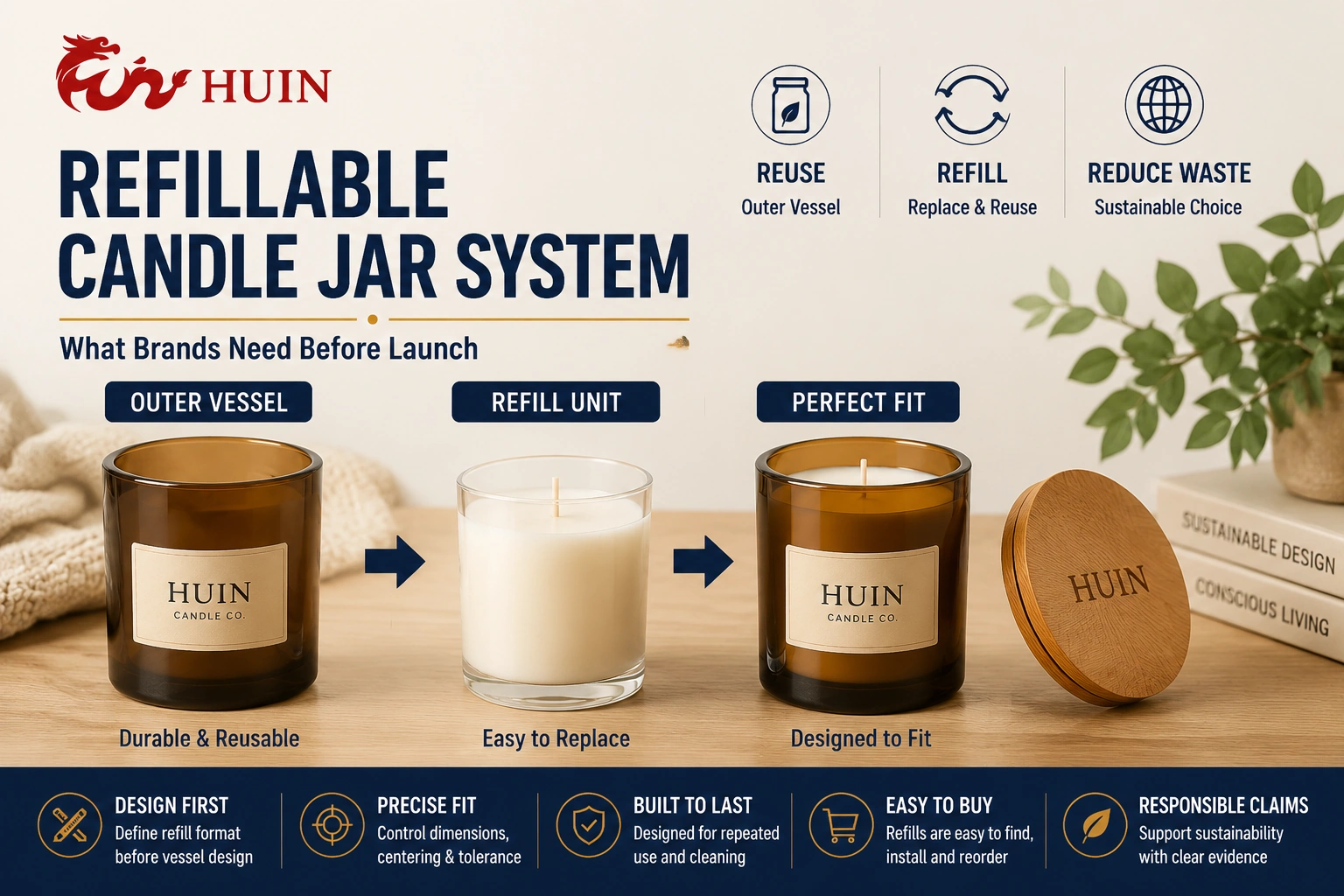
Refillable Candle Jars: What Brands Need Before Launch
Developing refillable candle jars requires more than a reusable container. Brands need to validate the vessel, refill structure, dimensional fit, user experience and supply system as one complete product solution.

Quick Answer
A refillable candle jar is a complete product system, not simply a heavier reusable vessel. The outer jar, refill format, dimensional fit, wick position, user instructions, replacement supply and commercial model should be designed and validated together.
A successful refill system depends on compatibility, convenience and repeatable performance.
Key Takeaways
- Define the refill format before finalizing the outer candle vessel.
- Control internal dimensions and refill positioning.
- Validate the complete refill candle system under repeated-use conditions.
- Make replacement units easy to identify, purchase and install.
- Use sustainability statements only when supported by evidence.
1. Distinguish Reusable From Refillable Candle Jars
A reusable candle jar and a refillable candle jar are not the same product concept.
A reusable candle jar may continue to be used for storage or decoration after the candle has finished. A refillable candle jar is intentionally designed to receive a compatible replacement candle component and return to its original function.
This difference directly affects product design and brand positioning.
A durable outer vessel alone does not create a successful refill program if:
- Replacement units are difficult to obtain
- Refills fit inconsistently
- Customers need to modify the product themselves
- Installation is unclear
2. Choose the Refill Architecture First
The refill structure should be defined before designing the outer candle vessel.
Common refill concepts include:
- Contained refill cups
- Removable inserts
- Purpose-designed replacement units
The selected refill architecture determines:
- Internal diameter
- Vessel depth
- Rim structure
- Base support
- Removal clearance
Designing the decorative outer jar first and adding a refill later often creates fit and usability problems.
The refill should sit in a controlled position and remain stable during handling and use.
3. Control Fit, Centering and Tolerance
A refillable candle system requires controlled dimensional compatibility between the outer vessel and the refill unit.
The design should define a suitable tolerance range instead of relying only on one perfect sample.
Important parameters include:
- Clearance between vessel and refill
- Insertion force
- Removal method
- Vertical seating position
- Centering features
- Anti-rotation structure if required
The wick position inside the refill should remain controlled relative to the outer vessel.
The complete system should be validated using the approved:
- Outer candle jar
- Refill unit
- Candle formula
- Wick
- User instructions
Consistent refill performance depends on controlled dimensions, not only visual appearance.
4. Design for Repeated Handling
A refillable candle jar system is designed for repeated interaction. The outer vessel, finish, label and lid may experience:
- Heating and cooling cycles
- Cleaning
- Repeated installation
- Daily handling
Brands should define:
- Recommended care method
- Inspection requirements
- Conditions where the vessel should no longer be reused
Decorative finishes should also be reviewed according to the expected usage cycle.
A surface treatment that performs well for one-time use may not maintain the same appearance after repeated washing or contact with refill components.
Coatings, printing and decorative details should therefore be evaluated according to the intended product life cycle.
5. Make the Refill Easy to Buy and Use
Consumer adoption depends on convenience as much as product design.
Customers need:
- Clearly identified replacement size
- Simple installation instructions
- Reliable replacement availability
- A clear refill value proposition
During pilot programs, brands can evaluate:
- Refill reorder rate
- Fit complaints
- Damaged outer vessels
- Installation questions
- Packaging performance
- Operational cost
These findings can help improve the refill system before wider market launch.
6. Keep Environmental Claims Specific and Verifiable
A refill system may reduce the need to replace the outer vessel, but the actual environmental impact depends on multiple factors.
These factors include:
- Material selection
- Refill weight
- Packaging requirements
- Transportation distance
- Actual customer reuse behavior
Brands should avoid broad claims such as:
- Zero waste
- Completely sustainable
unless these statements are supported by reliable evidence.
More accurate statements can explain:
- Which component is retained
- What material reduction is achieved
- How many reuse cycles are intended
- What supporting data is available
Refillable System Development Checklist
| System Element | What to Define | Failure to Avoid |
|---|---|---|
| Outer Vessel | Internal geometry, durability and care method | Refill does not fit or vessel is damaged during reuse |
| Refill Unit | Dimensions, wick position and removal method | Movement, inconsistent fit or incorrect installation |
| User Instructions | Installation, use, cleaning and damage checks | Customer improvisation or unsafe reuse |
| Replacement Supply | SKU identification, availability and pricing | Customers cannot find or justify refills |
| Environmental Claims | Specific statements and supporting evidence | Unverifiable sustainability marketing |
How HUIN Develops Refillable Candle Vessel Systems
HUIN is a candle jar manufacturer that develops the outer vessel based on the selected refill architecture.
The development process focuses on controlling:
- Internal vessel geometry
- Rim and base structure
- Surface finish requirements
- Physical sample approval
- Repeat-order specifications
These controls help maintain consistent fit between the outer candle jar and refill components.
HUIN can also support related development including:
- Lid development
- Insert design
- Protective packaging development
A refillable candle format should be reviewed as a complete product system rather than separate individual components.
Brands and qualified partners remain responsible for validating:
- Candle formulation
- User instructions
- Environmental claims
Frequently Asked Questions
Can any candle jar be converted into a refillable candle jar?
Not reliably. A refillable system requires suitable vessel geometry, dimensional consistency, durability, removal clearance and a validated refill structure.
Is a reusable candle jar the same as a refillable candle jar?
No. A refillable candle jar requires a compatible replacement candle component and an ongoing supply system.
Can customers pour their own wax into the outer candle jar?
This should not be assumed to be suitable. A purpose-designed refill format with clear instructions and product validation provides better control of performance and safety.
What makes a refill fit consistently?
Consistent refill performance requires controlled vessel and refill tolerances, defined seating position, stable centering features and physical validation using representative samples.
How can brands support sustainability claims?
Brands should use specific environmental statements supported by documented material, packaging or lifecycle data and review requirements in the target market.
What makes customers adopt candle refills?
Adoption depends on convenient availability, clear identification, simple installation, reliable fit and an understandable repeat-purchase value.
Recommended Internal Links
Develop the Refill and Outer Vessel as One System
A successful refillable candle jar requires coordinated development between the outer vessel, refill component, dimensional control, user experience, packaging and long-term supply system.
Before market launch, brands should validate:
- Refill compatibility
- Product durability
- User operation
- Packaging performance
- Repeat production consistency
A complete system approach helps create a more reliable refillable candle product and supports long-term product development.