

Private Label Candle Jar Manufacturing Process | HUIN
Discover the private label candle jar manufacturing process from product concept, engineering samples and customization to mass production, quality inspection and export packaging.
HUIN INDUSTRY INSIGHTS | CANDLE JAR MANUFACTURING & OEM PRODUCTION
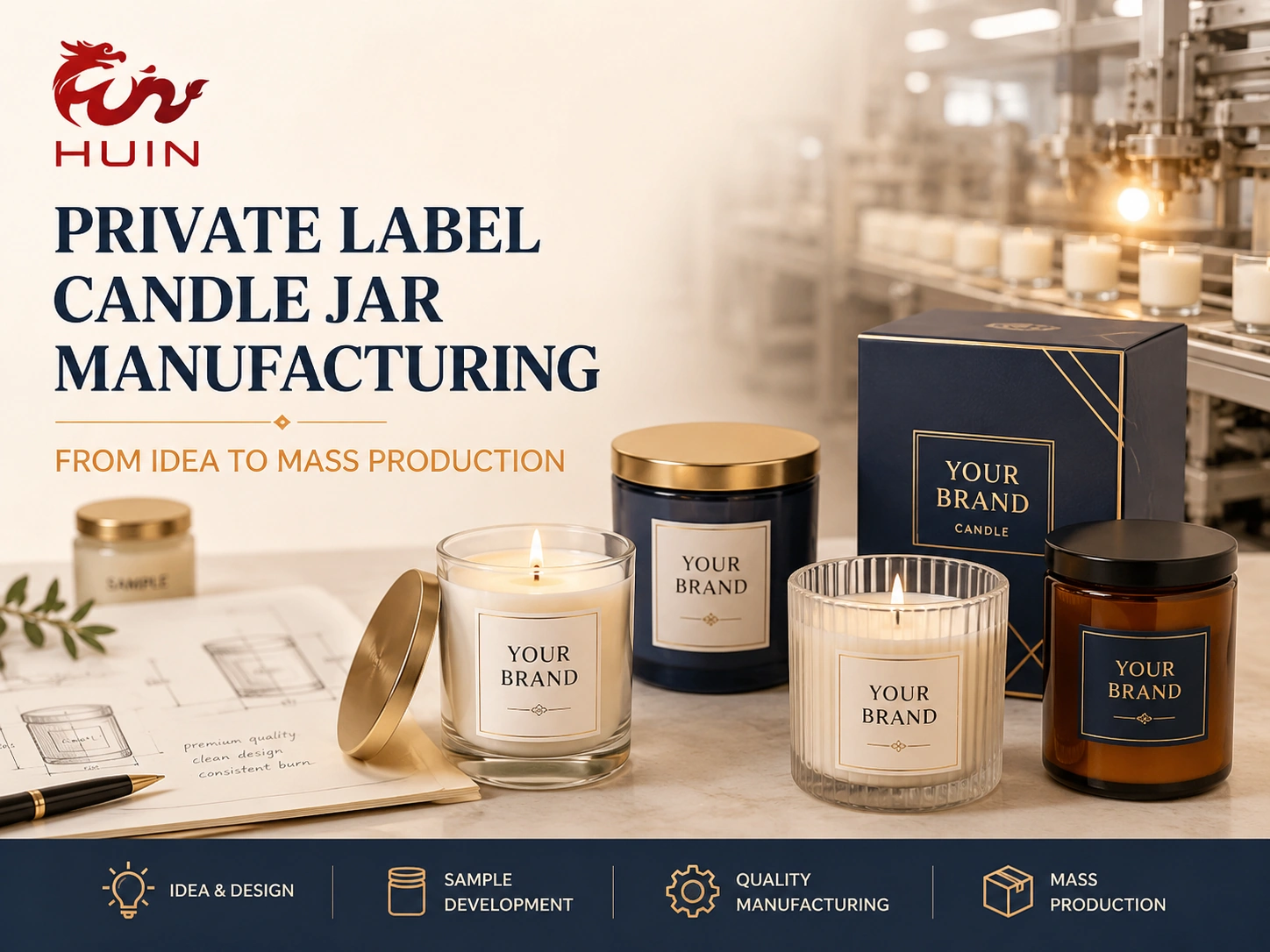
Private Label Candle Jar Manufacturing: From Idea to Mass Production
Follow the private label candle jar manufacturing process from product brief and engineering to samples, production, inspection, export packing and repeat-order control.

Quick Answer
A private label candle jar program should move through controlled manufacturing stages: defining the product brief, selecting the manufacturing route, approving engineering and appearance samples, freezing specifications, completing production, inspection, export packing and repeat-order controls.
Each stage should be approved before moving to the next step. This reduces uncontrolled changes and improves consistency for mass production.
Key Takeaways
- Start with one written brief covering the jar, components, packaging and launch requirements.
- Complete engineering approval before appearance development is considered final.
- Freeze drawings, samples, artwork, tolerances and packaging before mass production.
- Use documented inspection and milestone controls throughout manufacturing.
- Carry approved standards into every repeat order.
Stage 1: Define the Commercial and Technical Brief
A private label candle jar project begins with understanding the target market, customer position, sales channel, annual volume, launch schedule and destination market.
The product brief should include:
- Wax fill requirement
- Jar dimensions
- Material preference
- Surface finish
- Logo requirements
- Lid design
- Packaging method
- Shipping requirements
Mandatory requirements should be separated from preferences. This helps the manufacturer identify suitable existing molds, customization options and tooling requirements instead of presenting unrelated catalog products.
Stage 2: Select the Manufacturing Route
The manufacturing route should match the required differentiation, order volume, timeline and total project cost.
Possible routes include:
- Using an established mold
- Modifying products through components and decoration
- Developing a new private mold
The decision should consider:
- Product differentiation
- Tooling investment
- Sample development time
- Dimensional risk
- Total landed cost
At this stage, the project should confirm the proposed jar structure, dimensions, capacity, decoration direction and components that may affect MOQ or lead time.
Stage 3: Approve Engineering Samples
Engineering samples verify the technical foundation of the candle jar before final appearance development.
The review should confirm:
- Jar dimensions
- Capacity
- Rim and base geometry
- Lid compatibility
- Label area
- Product stability
- Packaging compatibility
Each sample should include a sample code and drawing version. Unsuitable designs should be eliminated before investing in final colors, logos or retail packaging samples.
Stage 4: Approve Appearance and Component Samples
After the vessel is technically approved, the project can move into appearance development.
The appearance sample should evaluate the complete assembled product, including:
- Glass color
- Surface finish
- Logo application
- Lid design
- Packaging presentation
Physical samples should be reviewed as a complete set because the combination of glass color, wax color, lid proportion, logo position and packaging structure affects the final product presentation.
Approval records should identify:
- Artwork version
- Color or finish standard
- Logo tolerance
- Lid specification
- Package structure
Digital renderings can support communication, but they should not replace physical sample approval.
Stage 5: Freeze the Production Specification
Before mass production begins, the final production specification should be documented and approved.
The production specification should reference:
- Approved drawings
- Sample codes
- Mold number
- Finish standard
- Artwork files
- Components
- Visible-defect criteria
- Packing method
- Inspection plan
- Shipping marks
No material, mold, finish or process substitution should occur without written review.
A frozen specification protects the production schedule by preventing uncontrolled design changes after manufacturing has started.
Stage 6: Manufacture, Decorate and Control the Order
Production planning should cover the complete manufacturing process, including:
- Vessel manufacturing
- Applicable process controls
- Surface finishing
- Logo application
- Component preparation
- Packing material readiness
- Inspection planning
Production updates should report completed milestones and current risks rather than only confirming that an order is “on schedule”.
In-process inspections should focus on characteristics that cannot be corrected after the next manufacturing stage.
Important control points include:
- Appearance
- Dimensions
- Surface finish
- Component fit
Stage 7: Inspect and Approve Export Packing
Final inspection should verify that the finished order matches the approved production standard.
Inspection should include:
- Product identity
- Quantity
- Key dimensions
- Visible quality
- Finish condition
- Logo placement
- Lid fit
- Packaging
- Labels and shipping marks
Export packaging should protect both the glass structure and decorative surfaces during the actual transportation route.
Packing and loading photos provide evidence of the approved configuration and support traceability after shipment.
Stage 8: Protect Repeat-Order Consistency
After delivery, feedback from production and market use should be recorded for future orders.
Important records include:
- Filling feedback
- Breakage information
- Surface damage
- Component-fit issues
- Customer comments
Corrective actions should be linked to the production batch and retained with the manufacturing file.
A repeat order should restart from the controlled:
- Drawing
- Golden sample
- Finish standard
- Approved packaging method
Skipping these references to save time can create avoidable product variation.
Private Label Manufacturing Milestones
| Stage | Required Output | Approval Gate |
|---|---|---|
| Brief | Commercial targets and technical requirements | Feasible scope and manufacturing route |
| Engineering | Drawing, sample code, dimensions and component fit | Technical sample approval |
| Appearance | Finish master, artwork, lid and packaging set | Physical appearance approval |
| Specification Freeze | Final production and inspection documents | Written authorization for mass production |
| Manufacturing | Milestone updates and in-process controls | Readiness for final inspection |
| Shipment | Inspection result, packing and loading records | Release for shipment |
| Repeat Order | Feedback and corrective-action record | Confirmed unchanged or approved revision |
HUIN’s Private Label Manufacturing Workflow
HUIN is a candle jar manufacturer supporting private label programs from vessel engineering and mold development through sampling, surface decoration, component matching, mass production, quality inspection and export packing.
Each manufacturing stage is linked to an approved deliverable, allowing the project to move forward based on controlled specifications instead of informal assumptions.
HUIN maintains key production references including:
- Approved drawings
- Golden samples
- Finish standards
- Packaging specifications
- Production records
These controlled references support consistency for repeat orders and help maintain the approved product standard throughout the manufacturing cycle.
Individual customization choices such as color, logo, lid and packaging are developed according to the specific private label project requirements.

Frequently Asked Questions
How long does a private label candle jar project take?
The timeline depends on whether an existing mold or private mold is selected, as well as finish processes, logo development, component approval, production capacity, inspection requirements and shipping route.
What information should I provide to a candle jar manufacturer?
A complete project brief should include target wax fill or dimensions, material preference, finish, logo, lid, packaging, quantity, launch date, destination market and required quality or compliance requirements.
When should candle jar mass production begin?
Mass production should begin only after engineering, appearance, components, packaging, defect criteria and production specifications have been documented and approved.
What is the difference between a custom candle jar options guide and a manufacturing process guide?
A custom candle jar options guide explains choices such as colors, logos, lids, packaging and mold routes. A manufacturing process guide explains how an approved concept moves through engineering, sampling, production, inspection and shipment.
How can repeat-order consistency be protected?
Repeat-order consistency should be maintained through controlled drawings, mold numbers, golden samples, finish standards, artwork versions, defect criteria and documented change approval processes.
Who validates the finished candle product?
The candle brand and qualified testing partners validate the complete candle system, including formula, wick, fill level and intended use. The manufacturer controls the approved vessel and manufacturing specifications.
Recommended Internal Links
Move From Concept to Controlled Production
A successful private label candle jar program depends on controlled development from the initial concept through repeat production.
Maintaining approved:
- Drawings
- Samples
- Specifications
- Inspection standards
- Packaging requirements
helps brands build a more consistent and scalable candle product supply system.
A structured manufacturing workflow connects product ideas with reliable production execution and long-term repeat-order stability.