


Custom Candle Jars: Colors, Logos, Lids & Packaging | HUIN
Compare custom candle jar colors, logo methods, lids, packaging and private molds to choose the right manufacturing route for your brand.
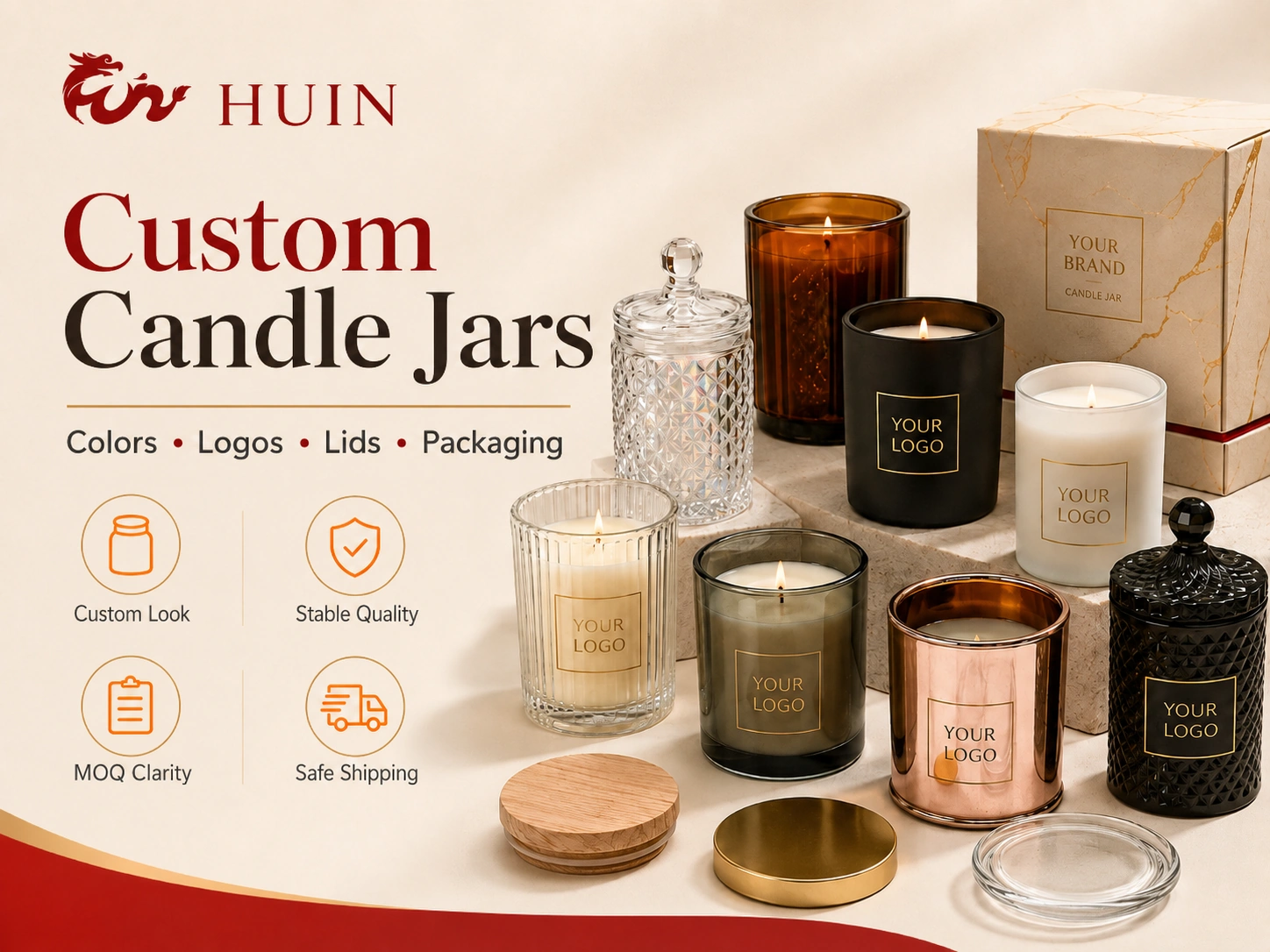
Custom Candle Jars: Colors, Logos, Lids and Packaging Options
How brands can compare candle jar colors, logo methods, lid options, packaging structures and private-mold development before selecting a custom manufacturing route.

Quick Answer
Custom candle jars can be developed through three main manufacturing routes: decorating an existing candle jar, combining an existing jar with custom components, or creating a private-mold vessel.
The right route depends on the brand’s required differentiation, order volume, budget, launch schedule and tolerance for development risk. The customization route should be selected before individual colors, logos, lids or packaging details are finalized.
Key Takeaways
- Choose the customization route before comparing individual finishes.
- Approve color and logo appearance on physical glass samples.
- Develop the lid and retail packaging around the actual candle jar tolerances.
- Identify which component controls MOQ, sampling cost and lead time.
- Document mold ownership, finish standards and repeat-order controls in writing.
1. Select the Appropriate Customization Route
The manufacturing route determines the project’s tooling requirements, development time, minimum order quantity and technical risk.
Existing Candle Jar With Custom Decoration
The lowest-risk route is to use an established candle jar shape and customize its surface finish, color, logo and packaging.
This route usually requires less tooling and allows the brand to focus differentiation on:
- Custom glass color
- Frosting or coating
- Printed or applied logos
- Labels and sleeves
- Retail and gift packaging
Existing Jar With Custom Components
A second route combines an established glass vessel with a custom lid, insert, label, sleeve or retail box.
This approach can create a more distinctive product system without changing the glass mold.
Private-Mold Candle Jar
A private-mold vessel offers the highest level of structural differentiation.
It is most appropriate when the candle jar shape itself is intended to become a strategic brand asset and the projected order volume supports tooling, sampling, validation and long-term mold maintenance.
Buyer Focus: A private mold is not automatically the best route. The additional differentiation should justify the higher tooling cost, longer development cycle and greater validation requirement.
Customization Route Comparison
| Customization Route | Best For | Main Controls |
|---|---|---|
| Existing jar + decoration | Faster launches and lower development risk | Physical color master, logo position and finish tolerance |
| Existing jar + custom components | Brands requiring stronger presentation without developing a new glass mold | Jar-and-lid fit, component MOQ, packaging and assembly checks |
| Private-mold candle jar | Higher-volume programs where vessel shape is a core brand asset | Tooling agreement, dimensional approval, validation and mold maintenance |
2. Choose a Color and Surface Finish That Can Be Repeated
Custom glass candle jars can be developed using several color and surface-finishing methods.
Common Options Include:
- Clear glass
- Internally colored glass
- External spray coating
- Frosted finishes
- Decorative coatings
- Electroplated effects
- Gloss, matte or translucent surfaces
Each method has different implications for:
- Appearance
- Durability
- Color tolerance
- Minimum order quantity
- Production cost
- Lead time
Why Physical Color Approval Matters
A digital color reference or Pantone code is useful for defining the design direction, but it cannot fully predict the final appearance on glass.
Glass thickness, surface texture, lighting conditions and wax color may all influence the perceived result.
The approved production standard should include a coded physical color master.
The acceptable range should define: hue, gloss, opacity, coating coverage and visible variation.
3. Match the Logo Method to the Design and Order Model
Different logo methods create different visual, commercial and production results.
| Logo Method | Main Advantage | Main Control |
|---|---|---|
| Screen printing | Clean, direct decoration on the candle jar surface | Ink color, artwork position, registration and curing |
| Decals | Supports detailed or multi-color decoration | Application position, firing or curing method and visual tolerance |
| Labels | Greater flexibility for fragrances, regulatory text and smaller design changes | Label material, adhesive, placement and environmental resistance |
| Embossing or debossing | Creates a permanent dimensional brand detail | Tooling, relief depth, mold release and dimensional consistency |
| Molded branding | Integrates brand identity into the candle jar structure | Private-mold development, drawing approval and tooling control |
Confirm the artwork format, logo size, position, orientation and acceptable tolerance before sampling.
Important: A logo should be reviewed on the curved or tapered surface of the actual candle jar, not only on a flat artwork file.
4. Treat the Lid as a Functional and Visual Component
Wood, metal, glass and other lid constructions use different fit systems, weights, inserts and surface finishes.
Check the Complete Jar-and-Lid System
- Lid contact points
- Insert material
- Retention and removal force
- Potential material odor
- Finish compatibility
- Clearance around the jar rim
- Weight added to the finished product
A lid can increase perceived product value, but it can also introduce assembly variation and additional shipping weight.
Approval Principle: Test the candle jar and lid as a matched set across multiple representative samples before bulk production.
5. Design Packaging Around the Finished Candle Jar
Retail boxes, inserts, sleeves and gift packaging should protect both the glass structure and the decorative finish.
A coated or printed surface may be scratched by direct contact even when the candle jar itself does not break.
Packaging Development Should Consider:
- Glass protection
- Surface-abrasion protection
- Jar-and-lid fit
- Insert structure
- Packing density
- Master carton dimensions
- Storage efficiency
- E-commerce parcel size
- Fulfillment method
Commercial Check: Premium packaging should have a clear purpose. Compare the improvement in presentation with its effect on unit cost, freight, storage and parcel dimensions.
6. Confirm Commercial Terms for Custom Manufacturing
Each component in a custom candle jar program may have a different minimum order quantity, sample charge and lead time.
The component with the highest MOQ or longest lead time may determine the practical launch plan.
Confirm Commercial Constraints for:
- Glass production
- Color or coating process
- Logo decoration
- Custom lids
- Packaging inserts
- Retail boxes
- Private-mold tooling
Private-Mold Agreement
For a private candle jar mold, the written tooling agreement should define:
- Tooling payment
- Mold ownership
- Storage conditions
- Maintenance responsibility
- Modification rights
- Exclusivity terms
- Change-approval rules
Repeat-order consistency should be protected through the approved drawing, mold number, physical master and written change-control procedure.
HUIN Custom Candle Jar Control Process
- Select the manufacturing route. Choose stock-mold decoration, custom components or private-mold development.
- Confirm the vessel standard. Approve the candle jar drawing, dimensions, finish direction and sample code.
- Approve physical decoration samples. Confirm the physical color master, logo artwork version, position and tolerance.
- Check component compatibility. Test the jar, lid, insert and packaging using representative samples.
- Develop packaging around the finished jar. Protect the glass, coating, printing and lid during handling and shipping.
- Control bulk production. Inspect production against the approved drawings, artwork versions, finish masters and inspection criteria.
How HUIN Manufactures Custom Candle Jars
As a candle jar manufacturer with its own factory, HUIN provides stock-mold customization, private-mold development, color and surface finishing, logo application, lid matching and retail-packaging support.
The manufacturing route is selected according to the brand’s design target, order quantity, launch schedule and required level of differentiation.
HUIN develops and approves physical samples for the candle jar and selected decoration before bulk production.
Production standards are controlled through approved drawings, sample codes, artwork versions, physical finish masters and inspection criteria.
Frequently Asked Questions
What is the lowest-risk way to create custom candle jars?
Use a proven candle jar shape and differentiate it with a controlled color, finish, logo, lid and packaging system. This reduces tooling and dimensional-development risk.
Is screen printing better than a label?
Neither method is always better. Screen printing creates a direct decorated appearance, while labels provide greater flexibility for multiple fragrances, regulatory information and smaller design changes.
Can a glass candle jar color match a Pantone code exactly?
A Pantone reference is useful as a target, but the final appearance should be approved on a physical glass sample with an agreed tolerance range.
Who owns a private candle jar mold?
Ownership depends on the written tooling agreement. Payment, storage, maintenance, modification rights and exclusivity should be confirmed before mold development begins.
Should packaging be designed after the candle jar is finished?
No. The candle jar, surface finish, lid and packaging should be developed together because fit, abrasion protection, packing density and freight are connected.
What usually determines the MOQ for custom candle jars?
The controlling MOQ may come from the glass production run, color process, logo method, lid, insert or retail packaging rather than from the candle jar alone.
Related Reading
Choose the Customization Route Before Finalizing the Design
Brands should confirm the required level of differentiation, order volume, launch schedule, component MOQ and development risk before approving candle jar colors, logos, lids or packaging.
Physical samples, controlled artwork versions, approved finish standards and written tooling terms provide the basis for consistent bulk production and repeat orders.