


How to Pack Candle Jars for International Shipping | HUIN
Learn how to pack glass candle jars for international shipping with proper separation, surface protection, cartons, pallets and transportation control.
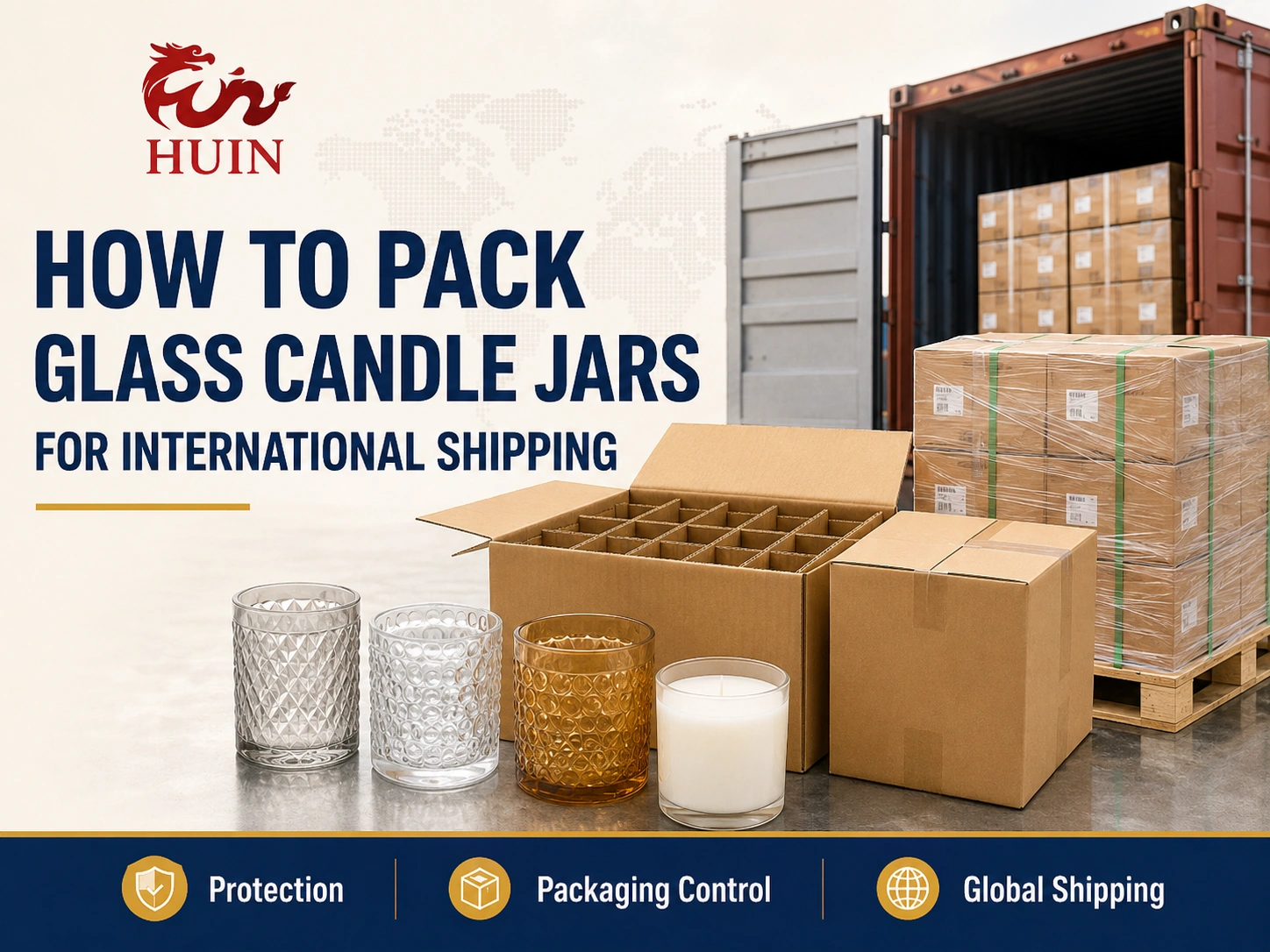
How to Pack Glass Candle Jars for International Shipping
Learn how separation, surface protection, cartons, pallets, route validation and loading control reduce glass candle jar damage during international transportation.

Quick Answer
Reducing glass candle jar breakage during international shipping requires a complete packaging system. Each vessel should be separated, decorated surfaces protected, carton movement controlled, pallets stabilized and the final packaging verified according to the actual transportation route.
Adding more packaging material alone does not guarantee lower damage rates. The packaging structure must address the actual risks during handling, storage and transportation.
Key Takeaways
- Identify the actual damage mechanism before selecting packaging materials.
- Design the inner pack and master carton as one complete system.
- Protect decorated surfaces from abrasion as well as protecting glass from impact.
- Control carton weight, pallet arrangement and loading conditions.
- Maintain packing and loading records for repeat orders and damage analysis.
1. Identify How Glass Candle Jar Damage Is Likely to Occur
Glass candle jars may be damaged through multiple transportation conditions, including:
- Direct impact
- Jar-to-jar contact
- Continuous vibration
- Carton compression
- Pallet movement
- Improper handling
Decorated candle jars may also experience surface issues even when the glass remains intact. Examples include:
- Scratches
- Rub marks
- Surface abrasion
- Finish damage
The correct packaging solution should match the actual failure mode. Adding unnecessary materials without controlling movement, contact points or carton structure may increase cost without improving protection.
2. Separate Every Glass Surface That Can Make Contact
Individual separation is one of the most important factors in protecting glass candle jars during transportation.
Packaging structures may include:
- Partitions
- Protective sleeves
- Molded trays
- Individual boxes
- Customized inserts
The inner structure should keep jars separated during repeated handling and vibration. The insert should remain stable instead of collapsing or shifting inside the carton.
For finished products with:
- Frosted coating
- Printed decoration
- Electroplated surfaces
- Special finishes
Additional abrasion protection may be required. Packaging tests should use representative finished samples rather than unfinished clear glass.
3. Balance Carton Strength, Size and Handling Weight
The master carton should provide enough protection during stacking, transportation and handling while avoiding unnecessary weight and empty space.
Packaging design should balance:
- Carton strength
- Internal space utilization
- Gross weight
- Handling requirements
- Transportation conditions
Oversized cartons may create additional movement inside the package and increase impact risk. Extremely heavy cartons may increase handling difficulty and create additional stress on lower pallet layers.
Before approval, confirm:
- Units per carton layer
- Number of carton layers
- Gross carton weight
- Carton closure method
- Product orientation
The inner packaging and master carton should be approved as one complete configuration.
4. Stabilize the Pallet Without Crushing the Cartons
Pallet stability is essential for international transportation because unstable loads may move during handling and create carton damage.
A suitable pallet system should consider:
- Carton alignment
- No unsupported carton overhang
- Edge protection
- Stretch wrap control
- Strap application
- Total pallet height
- Total pallet weight
Packaging restraints should secure the load without applying excessive pressure that may deform cartons.
The pallet structure should match the transportation method and final handling environment.
Different shipping routes may require different pallet protection strategies.
5. Verify Packaging for the Actual Shipping Route
A packaging solution should be evaluated according to the actual distribution route.
Different transportation methods create different risks:
- Full container ocean shipment
- Less-than-container-load consolidation
- Courier transportation
- E-commerce fulfillment delivery
The verification process should use:
- Representative candle jars
- Final decoration finishes
- Approved carton structure
- Actual pallet arrangement
Approved packaging specifications should be recorded to ensure repeat orders follow the same packing method.
6. Inspect Packing and Loading Before Shipment
Pre-shipment inspection helps confirm that the approved packaging system is correctly applied before the goods leave the factory.
Inspection should verify:
- Jar orientation
- Separator placement
- Carton closure
- Quantity accuracy
- Shipping marks
- Pallet condition
- Container cleanliness
Photos of packing and loading provide valuable references for future repeat orders and damage investigations.
When a shipping claim occurs, the analysis should compare:
- Batch information
- Packing records
- Carton condition
- Loading photos
- Damage location
- Transportation route
Export Packaging Control Points
| Packaging Level | Control Focus | Risk Addressed |
|---|---|---|
| Jar | Individual separation and finish protection | Impact, chipping and abrasion |
| Inner Pack | Stable partitions, trays or individual boxes | Movement and jar-to-jar contact |
| Master Carton | Carton structure, fitting and gross weight | Compression, drops and handling stress |
| Pallet | Alignment, edge protection and load restraint | Load movement and carton collapse |
| Shipment | Route verification and loading records | Distribution hazards and traceability |
How HUIN Designs and Controls Export Packaging
HUIN is a candle jar manufacturer that develops export packaging based on the approved vessel structure, decoration requirements, lid configuration and transportation route.
Packaging evaluation considers:
- Glass protection requirements
- Surface finish protection
- Carton strength
- Packaging weight control
- Pallet stability
- Shipping environment
Packaging trials are evaluated with representative finished candle jars to confirm:
- Jar separation performance
- Abrasion protection
- Carton configuration
- Transportation stability
During production, HUIN controls approved packaging requirements including:
- Separator specifications
- Carton structure
- Shipping marks
- Pallet arrangement
- Packing and loading records
This connects manufacturing quality with the condition in which candle jars arrive at the buyer’s location.
Frequently Asked Questions
Is thicker corrugated board enough to prevent candle jar breakage?
No. Carton strength is only one factor. Packaging performance also depends on jar separation, internal fitting, cushioning, carton size, gross weight, pallet stability and transportation conditions.
Should lids be packed on candle jars during shipping?
It depends on lid retention, abrasion risk, packing density and assembly requirements. Different packaging configurations should be evaluated using representative samples before approval.
What packaging test should be used for glass candle jars?
The verification method should reflect the actual shipping route and package format. Different requirements may apply depending on ocean transportation, courier delivery, consolidation or e-commerce fulfillment.
Can decorated candle jars use the same packaging as clear glass jars?
Not always. Frosting, coating, printing and electroplated finishes may require additional surface protection to prevent scratches and rubbing damage.
How should shipping breakage claims be investigated?
Damage analysis should review batch information, packing photos, carton condition, pallet status, loading evidence, damage location and transportation route before determining possible causes.
Recommended Internal Links
Approve the Packaging System Before Mass Shipment
Reliable glass candle jar transportation depends on a complete packaging system rather than a single protective material.
A professional export packaging solution should consider:
- Individual jar separation
- Surface finish protection
- Carton structure
- Pallet stability
- Route-specific verification
- Packing and loading records
HUIN focuses on candle jar manufacturing, packaging control and export preparation to support consistent product protection during international transportation.
A validated packaging system helps reduce avoidable damage risks and provides a more reliable foundation for repeat orders.