


Candle Jar Diameter and Wick Selection Guide | HUIN
Learn how internal candle jar diameter, geometry, wax, fragrance and wick construction interact during controlled burn testing.
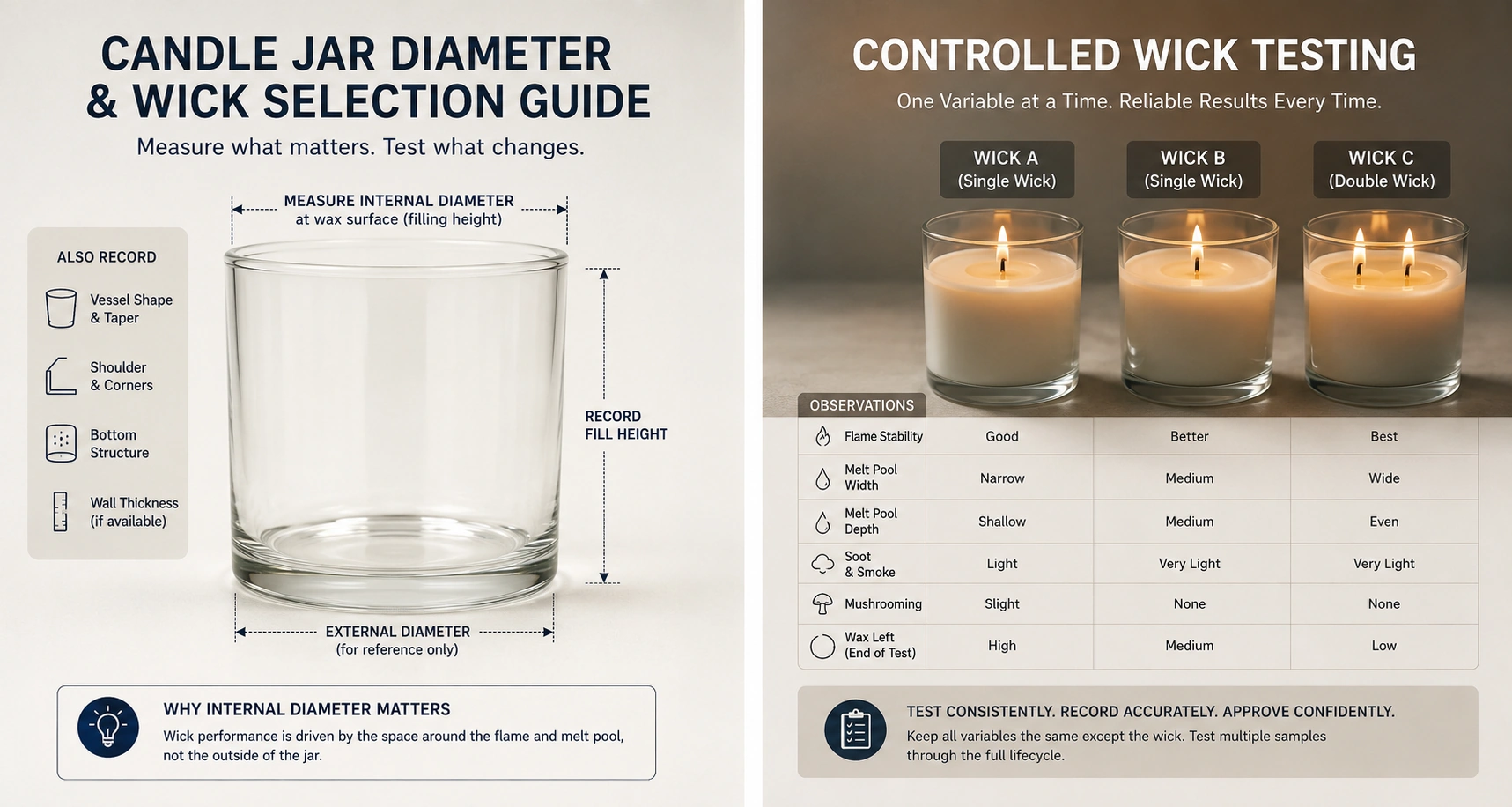
Candle Jar Diameter and Wick Selection: What Brands Should Test
How internal candle jar diameter, vessel geometry, wax formulation, fragrance and wick construction interact during controlled burn testing.

Quick Answer
Candle jar diameter defines a starting range for wick development, not a final wick answer.
Candle jar diameter and wick size must be evaluated as part of the complete candle system rather than treated as a fixed one-to-one specification. Internal dimensions, vessel shape, wax blend, fragrance, additives, wick construction and target burn behavior must be tested together under controlled conditions.
Key Takeaways
- Measure the internal diameter at the actual wax surface.
- Record taper, corners, shoulders and base geometry.
- Do not compare wick size codes across different wick families as if they are identical.
- Change one test variable at a time and keep complete records.
- Use multiple samples and complete-life burn testing before production approval.
1. Measure the Inside of the Candle Vessel
Product catalogues often emphasize outside diameter because it is easy to compare. However, wick development depends more directly on the internal space around the flame and melt pool.
Thick walls, vessel taper and shoulder geometry can make the working diameter meaningfully smaller than the external measurement.
Buyer Measurement Focus
Measure the internal candle vessel diameter at the intended wax fill height, not only the outside diameter shown in a product catalogue.
For square, oval or sculptural candle jars, record more than one internal dimension at the intended fill height.
Corners and unequal distances from the wick can change melt-pool development and heat distribution.
2. Treat Candle Jar Diameter as a Starting Variable
Wick charts can help identify an initial test range, but they cannot account for every candle formula and vessel geometry.
A wide candle jar may require:
- One larger wick
- Two or more smaller wicks
- A different wick construction
- Adjusted wick spacing or centering
Important: Neither a single-wick nor a multi-wick arrangement should be selected from diameter alone. Wax depth, vessel shape, total heat output and complete-life performance must also be evaluated.
The height of the wax column, base shape and changes in diameter lower in the candle jar can affect end-of-life behavior.
The burn-test plan should therefore cover the complete intended candle life rather than only the first few burn cycles.
3. Keep the Formula and Wick Specification Exact
Soy, paraffin, coconut and blended wax systems have different melting and combustion behavior.
Fragrance identity, fragrance load, dye and other additives can also change the result. Two fragrances used at the same percentage may still require different wick development.
Record the Complete Wick Specification
- Wick family
- Wick construction
- Wick size
- Wick treatment
- Wick tab
- Adhesive
- Supplier identification
Do not assume that the same wick size number means the same performance across different wick families or suppliers.
Wick codes are specific to their product families and should be recorded exactly throughout development and production.
4. Use a Controlled Comparative Burn Test
Select a small group of plausible wick candidates and keep the other important variables consistent.
Variables to Keep Consistent
- Candle jar drawing and sample code
- Wax batch
- Fragrance identity and load
- Dye and additives
- Fill weight
- Curing conditions
- Burn schedule
- Testing environment
Observations to Record
- Flame stability and height
- Melt-pool width
- Melt-pool depth
- Soot development
- Wick mushrooming
- Wax consumption
- Glass vessel condition
- Remaining wax
Controlled Testing Principle: Change one variable at a time so that the development team can identify which wick or system change caused the observed result.
Promising combinations should be repeated across multiple samples.
Multi-wick candles also require repeatable wick spacing and centering fixtures during production because inconsistent placement can change melt-pool shape and heat distribution.
5. Define the Manufacturer and Brand Responsibilities
Clear responsibility boundaries help prevent the candle jar specification from changing while the formula and wick system are being developed.
| Responsible Party | Main Responsibilities |
|---|---|
| Candle jar manufacturer | Accurate internal dimensions, stable vessel specification, approved reference samples, production consistency and dimensional inspection |
| Candle brand or development partner | Wax selection, fragrance development, wick testing, formula validation and finished-candle approval |
This separation creates a clear basis for comparative testing and for deciding when retesting is required after a product or manufacturing change.
Controlled Wick Test Record
Use a controlled wick test record to keep the candle vessel, formula, test conditions and observations traceable.
| Variable to Hold Constant | Variable to Compare | Observation |
|---|---|---|
| Jar drawing and sample code | Wick family and size | Flame stability and height |
| Wax, fragrance and dye | Single wick versus multiple wicks | Melt-pool shape and heat distribution |
| Fill weight and cure time | Wick spacing or centering | Soot, mushrooming and remaining wax |
| Burn schedule and environment | Promising candidate repeats | Complete-life consistency across multiple samples |
What HUIN Provides for Wick Development
As a candle jar manufacturer with its own factory, HUIN controls the internal and external vessel dimensions, rim geometry, base geometry, surface finish, sample identification and repeat-order specification.
These controls provide candle-development teams with a stable and repeatable vessel for comparative wick testing.
HUIN can provide:
- Representative technical samples
- Internal and external dimensional records
- Approved sample codes
- Controlled vessel drawings
- Production inspection against the approved jar standard
- Repeat-order manufacturing consistency
The candle brand retains responsibility for wick selection, formula validation, controlled burn testing and finished-candle approval.
Frequently Asked Questions
Can a wick be selected from candle jar diameter alone?
No. Candle jar diameter identifies a starting test range, but final wick selection requires testing with the complete vessel, wax, fragrance, additives and intended fill level.
When should a candle use two wicks?
A wide or irregular vessel may benefit from multiple wicks, but wick spacing, total heat output, melt-pool development and complete-life performance must be validated.
Why can one fragrance require a different wick?
Fragrance composition can change wax flow and combustion behavior even when the fragrance-loading percentage remains unchanged.
How many candle samples should be tested?
Use multiple samples for promising combinations and test them through the intended candle life. The exact sample plan should reflect product risk and destination-market requirements.
Should a candle be retested after changing jar manufacturers?
Yes, when the vessel geometry, glass distribution, dimensions or manufacturing characteristics may differ from the approved candle jar specification.
Related Reading
Lock the Vessel Specification Before Final Wick Approval
Final wick approval should be based on a controlled candle jar specification, exact formula records, multiple representative samples and complete-life burn testing.
When the candle jar, formula, wick or manufacturing specification changes, the development team should review whether new samples or repeat testing are required.