


2026 Candle Jar Trends: Premium Designs & Market Insights
Explore the leading 2026 candle jar trends, including premium glass vessels, matte finishes, metallic interiors, embossed textures and refillable designs.
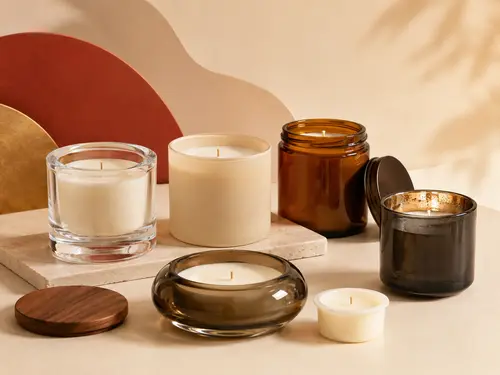
Which Candle Jar Trends Are Driving Market Growth in 2026?
A practical guide for candle brands and global buyers evaluating premium glass vessels, decorative finishes, refill systems and scalable custom candle jar programs.
Quick Answer
The strongest candle jar opportunity in 2026 is the premium home fragrance vessel: a container that protects the candle, communicates the brand and remains visually valuable as home décor. Thick-base glass, quiet luxury colors, matte or metallic finishes, coordinated lids, gift-ready packaging and refill-compatible formats are creating more differentiation than basic transparent jars alone.
Key Takeaways
- Market outlook: Third-party forecasts indicate continued growth in both the candle jar market and the luxury candle category, although their growth rates are not directly comparable.
- Premium direction: Thick-base glass, matte surfaces and controlled metallic effects support premium positioning.
- Higher-value innovation: Refillable and reusable vessel concepts are turning packaging into a longer-term home décor object.
- Scalable core: Classic 8–12 oz straight-sided jars remain important for scalable private-label programs.
- Manufacturing priority: Product structure, decoration and export packaging should be developed as one manufacturing system.
Introduction: The Candle Jar Is Becoming Part of the Product Experience
A candle jar is no longer viewed only as a functional container. In the home fragrance market, it also influences perceived product quality, shelf impact, gifting value and the way a fragrance collection fits into the consumer’s interior space.
This development is especially relevant for private-label candle brands, retailers, hospitality projects and gift companies. When fragrance formulas are difficult to evaluate online, the vessel becomes one of the clearest visual signals of brand position.
Third-party forecasts indicate continued growth in both the candle jar market and the luxury candle category. Grand View Research estimates that the global luxury candle market generated approximately USD 667.9 million in 2025 and projects a compound annual growth rate of 10.8% from 2026 to 2033. Its published summary also states that container candles accounted for 52.2% of luxury candle revenue in 2025.
Future Market Insights estimates the global candle jar market at approximately USD 1.35 billion in 2026 and projects it to reach about USD 1.94 billion by 2036, representing a forecast compound annual growth rate of 3.7%. Because the two reports examine different markets, use different methodologies and cover different forecast periods, their growth rates should not be compared directly. Together, they indicate continued commercial interest in candle vessels and premium home-fragrance presentation.
What the data means for buyers: The goal is not simply to make a jar more expensive. It is to create a vessel system in which glass quality, structure, finish, lid, packaging and brand identity work together.
1. Premium Glass Vessels Are Becoming Brand Assets
For brands competing in middle and premium price segments, a generic jar can make a distinctive fragrance appear interchangeable. A well-planned custom candle jar can instead become a recognizable asset that continues across core, seasonal and limited-edition collections.
Current premium development commonly focuses on:
- thick walls and a visually substantial glass base;
- straight-sided, softly tapered or low wide profiles;
- high-clarity glass for controlled color and decoration;
- coordinated jar, lid and gift-box systems;
- repeatable structures that support multiple fragrance or seasonal color extensions.
Not every project requires a completely new mold. Buyers can often build a premium-looking product from an established vessel structure by combining the appropriate glass weight, finish, logo process, lid and packaging.

2. Quiet Luxury Colors and Tactile Finishes Support Premium Positioning
Neutral and nature-influenced colors remain commercially practical because they coordinate with many interior styles and fragrance families. Cream white, amber brown, smoke gray, olive green, deep burgundy and soft black provide a useful foundation for 2026 premium collections.
The surface treatment can influence perceived value as much as the color itself:
| Process | Visual Effect | Development Consideration |
|---|---|---|
| Matte spraying | Soft, low-gloss and tactile | Color consistency and abrasion protection |
| Inner electroplating | Warm reflected candlelight | Coverage, adhesion and compatibility evaluation |
| Silk-screen printing | Controlled logo and product detail | Artwork scale, registration and ink selection |
| Hot stamping | Selective metallic highlight | Surface flatness and transfer consistency |
| Frosting or gradient color | Layered transparency | Gradient control and batch consistency |
The strongest result is not necessarily the jar with the most processes. Decoration should support the intended brand position while remaining stable during production, packing and normal product use.
3. Refillable and Reusable Vessels Are Moving Upmarket
Refill systems are becoming particularly relevant in premium home fragrance. A durable decorative vessel can remain in the home while the wax component is replaced, changing the consumer’s perception of the jar from disposable packaging to a reusable interior object.
Recent high-end launches have combined sculptural ceramic vessels with separately sold refills. One example is Tekla's refillable candle collection reported by Wallpaper*. This is a brand example rather than proof of category-wide sales performance. For glass candle jar programs, a similar concept can be explored through controlled internal dimensions, durable decoration, standardized refill formats and packaging that clearly explains reuse.
Environmental statements should remain specific and verifiable. Rather than using broad claims such as “zero waste,” brands can explain that the outer vessel is intended for repeated use or that a replacement insert reduces the need to replace the complete decorative container.
4. Sculptural Shapes and Multi-Wick Formats Increase Shelf Impact
Low, wide and organically curved vessels are receiving attention because they function as tabletop décor as well as fragrance containers. Multi-wick formats can support larger room applications and create stronger visual impact.
Distinctive form must still be evaluated as an engineered product. Buyers should review:
- wall and base thickness consistency;
- rim geometry and lid fit;
- wax volume, wick configuration and thermal performance;
- decoration coverage and dimensional tolerance;
- protective packaging and export transport stability.
5. The 8–12 oz Straight-Sided Jar Remains the Scalable Core
Sculptural containers may attract attention, but classic straight-sided candle jars remain important for volume purchasing. Capacities around 8 oz, 10 oz and 12 oz are familiar to many candle makers and can support broad fragrance ranges, private labels and seasonal launches.
Amber glass remains suitable for natural, apothecary and heritage-inspired branding. Smoke gray, matte cream and translucent color treatments can move the same core geometry toward a contemporary premium position. A black metal, gold-tone metal or wood-effect lid can further differentiate the range without changing the main vessel structure.
6. Packaging Must Be Developed as Part of the Candle Jar System
Premium surfaces can be damaged when packaging is treated as an afterthought. Matte coatings may show abrasion, metallic surfaces may reveal scratches, and heavy thick-base jars create greater impact forces during international transport.
Packaging development should consider glass weight, surface finish, lid material, internal spacing, carton strength, pallet arrangement, shipping route and handling conditions. Appropriate protection may include surface sleeves, fitted inserts, reinforced dividers or individual retail boxes.
For a deeper explanation of this topic, read Candle Jar Packaging for International Shipping.
Which Candle Jar Direction Should Buyers Develop First?
| Commercial Goal | Recommended Direction | Why It Matters |
|---|---|---|
| Scalable core collection | 8–12 oz straight-sided glass | Supports multiple fragrances and repeat orders |
| Premium brand upgrade | 10 oz thick-base glass with matte exterior and inner metallic finish | Combines premium appearance with scalable geometry |
| Gift and seasonal sales | Decorated vessel, coordinated lid and fitted gift box | Creates a complete presentation system |
| Design differentiation | Low wide or sculptural vessel | Builds stronger shelf and décor value |
| Repeat-purchase model | Durable vessel designed around a controlled refill format | Keeps the outer vessel in use longer |
HUIN Manufacturing Perspective
HUIN Own-Factory Advantage: As a custom candle jar manufacturer with its own factory, HUIN evaluates the vessel, decorative process and export packaging as one connected product system.
OEM and ODM development may include vessel selection, custom mold assessment, color matching, spraying, electroplating, silk-screen printing, hot stamping, lid coordination, gift packaging and transport protection.
The purpose is not to apply every available process to one container. It is to balance appearance, manufacturability, production consistency, target cost and delivery requirements. Buyers evaluating customization options can also review Custom Candle Jar Options.
Frequently Asked Questions
What candle jar style has the strongest opportunity in 2026?
Premium home fragrance vessels offer a strong opportunity, particularly thick-base glass jars with tactile finishes, coordinated lids and gift-ready packaging.
Are amber candle jars still commercially relevant?
Yes. Amber straight-sided jars remain suitable for natural, apothecary and heritage-inspired branding, particularly in scalable 8–12 oz programs.
Which decoration processes create a premium appearance?
Matte spraying, inner electroplating, silk-screen printing, hot stamping, frosting and controlled gradients can support premium positioning when matched to the vessel structure and brand design.
Can a candle jar be designed for refills?
Yes. Internal dimensions, heat performance, refill fit, user instructions and the durability of the outer decoration should be considered during the early development stage.
Why should packaging be tested with the finished decoration?
The final coating, lid and glass weight affect abrasion and impact risk. Evaluating the complete packed product provides more relevant information than testing an undecorated empty jar alone.
Related Reading
- Custom Candle Jar Options for Private-Label Projects
- Are Glass Candle Jars Heat Resistant?
- Candle Jar Packaging for International Shipping
Conclusion
The leading candle jar direction in 2026 is not defined by one color or one shape. It reflects a wider shift toward premium home fragrance vessels that combine visual identity, tactile finishes, interior compatibility and practical manufacturing.
For buyers, the most balanced starting point is often a thick-base 10 oz glass jar with a controlled matte finish, optional inner metallic effect, coordinated lid and packaging developed around the finished surface. Classic amber and straight-sided vessels remain important for scalable programs, while refillable and sculptural formats provide room for higher-value differentiation.
Industry data references: Grand View Research, Luxury Candle Market; Future Market Insights, Candle Jar Market; and Wallpaper*, Tekla's First Candles Come in Sculptural Ceramic Vessels. Sources accessed August 10, 2026.
Data and editorial note: Market figures cited in this article are third-party estimates. Forecasts may vary according to market definition, methodology and forecast period, and the growth rates cited above are not directly comparable. HUIN's product-development recommendations reflect manufacturing experience and should not be interpreted as verified marketplace sales rankings. Third-party names and links are provided for attribution and reader verification; no third-party report text, chart or image is reproduced.