


Compliance should be defined by product, destination market, supplier and actual production site.
Procurement & Sourcing Guides
Supplier Compliance Management 2026: 7 Controls Buyers Need
2026-09-15By HUIN Team
Learn 7 supplier compliance controls for retailers and distributors: risk mapping, document checks, traceability, audits, change control and shipment release

2026 Supplier Compliance Management Guide
Certificates Are Useful. They Are No Longer a Complete Compliance System.
Retailers and distributors increasingly need to know not only whether a supplier has documents, but whether the right product, factory, materials and upstream supply chain can be supported by current evidence.
Executive Summary
Supplier compliance is moving toward continuous verification, traceability and evidence. The goal is not to collect more certificates; it is to know when a supplier can safely be approved, monitored and released for shipment.
A document only proves what its legal entity, product scope, standard and validity actually cover.
Critical materials and subcontractors can create risk even when the direct supplier looks compliant.
High-risk shipments should pass a defined compliance gate before goods leave the factory.

Supplier Compliance Is No Longer a Folder Full of Certificates
For years, supplier compliance was often treated as a document collection exercise. A supplier sent a business license, certificates, audit reports and product test documents, and someone marked the supplier as approved.
That approach is increasingly inadequate.
A certificate can provide useful evidence, but it may not tell you whether the exact product being shipped today was produced at the approved factory, whether materials changed or whether critical work was subcontracted.
The Better Compliance Question Can we show current evidence that this product, from this supplier and this production site, meets the requirements of its destination market?
That question shifts compliance from document storage toward active supplier management.
Define Compliance by Product and Market — Not by Supplier Name
The question “Is this supplier compliant?” is usually too broad.
A supplier may be appropriate for one product but not another. A product may require different evidence depending on where it will be sold.
The correct compliance unit is usually a combination of:
Product + Destination Market + Supplier + Production Site
A practical compliance matrix makes those requirements visible before purchase orders are released.
| Requirement | Applies To | Evidence | Review Trigger |
|---|---|---|---|
| Business Registration | Supplier / Factory | Legal company record | Periodic review or entity change |
| Product Testing | Specific SKU | Applicable laboratory report | Expiry or material/product change |
| Material Compliance | Relevant SKU | Declaration or test evidence | Material change |
| Social Compliance | Production Site | Audit or assessment | Risk-based review |
| Traceability | Relevant Product / Material | Origin and upstream records | Supplier/source change |
| Label & Packaging | SKU / Destination | Approved artwork and specification | SKU or market change |
The goal is not to ask whether documents exist. The goal is to confirm that the correct evidence applies to the correct product.
Verify What Each Document Actually Proves
A PDF file should never be treated as compliance evidence until its scope is understood.
| Document | What It Can Support | What It Does Not Automatically Prove |
|---|---|---|
| ISO 9001 Certificate | Certified quality-management system within its stated scope | Specific product compliance or today's batch quality |
| Social Audit | Conditions observed and evaluated within the audit scope | That conditions remain unchanged indefinitely |
| Product Test Report | Results for the identified sample and standard | That a changed material or another SKU is covered |
| Business License | Legal existence of a company | Production capability or factory performance |
| Supplier Declaration | Supplier's documented statement | Independent verification of the statement |
A document review should verify the legal entity, factory address, issuing body, dates, standard, model or product scope, report number and current status.
This is especially important when a trading company, manufacturer and invoicing entity are not the same organization.
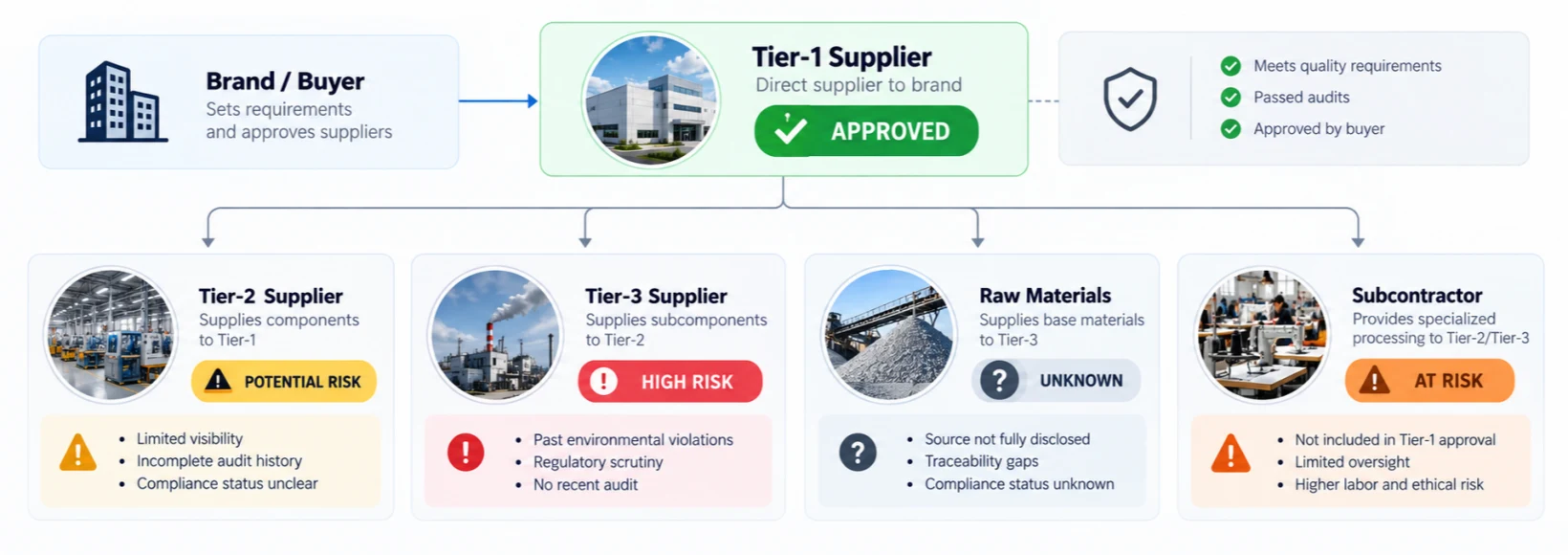
Map Critical Supply Chains Beyond Tier 1
Many procurement teams know their direct supplier but have limited visibility into critical upstream sources.
A finished product may rely on other companies for raw materials, electronics, coatings, packaging, metal components or specialist processing.
A Simplified Supply-Chain Map
Buyer Retailer, importer or distributor.
Tier 1 Final assembly or primary contracted manufacturer.
Tier 2 Critical component, material or process supplier.
Tier 3+ Raw material, origin or upstream source.
The deeper investigation should follow risk. Not every component requires identical treatment.
For critical materials, buyers should understand who manufactures the component, where it is produced, what upstream source is used and whether evidence supports that information.
This is increasingly relevant to forced-labour controls and product-origin traceability. U.S. CBP guidance emphasizes reasonable care and supply-chain understanding, while EU forced-labour preparation tools also focus on traceability and risk identification.
Tier-1 approval does not automatically equal supply-chain compliance.
Use Risk-Based Supplier Audits Instead of Auditing Everyone the Same
Compliance resources should follow risk.
A supplier producing a standard, easily replaceable low-risk item does not necessarily need the same audit intensity as a critical supplier with complex subcontracting or significant regulatory exposure.
Stable performance, simple product and limited compliance complexity.
Custom tooling, meaningful spend or moderate regulatory requirements.
Complex upstream sourcing, regulated products, strategic retail programs or limited alternatives.
Audit depth, frequency, testing and management attention can then be adjusted according to the consequence and likelihood of supplier failure.
The purpose of risk segmentation is not to audit less. It is to audit where the business needs the strongest control.
Control Supplier Changes Before They Invalidate Your Evidence
A supplier can pass qualification successfully and still become non-compliant later if key production conditions change.
Typical changes include raw-material sources, factories, subcontractors, formulations, components, coatings and production processes.
A change-control workflow should operate before those changes enter normal production.
Supplier Proposes Change Buyer Reviews Impact Testing / Approval if Needed Change Released
Depending on risk, a change may require new samples, updated laboratory testing, revised documents, another factory assessment or customer approval.
Compliance becomes outdated quietly when supplier changes happen faster than compliance records are updated.
Do Not Close Corrective Actions Until Evidence Is Verified
An audit finding is only the beginning of corrective action.
A supplier response saying “corrected” should not automatically close the issue.
Finding Root Cause Corrective Action Evidence Verified Closure
Evidence can include revised procedures, photographs, training records, calibration results, test reports or updated production controls.
The purpose of CAPA is not merely to repair one visible problem. It is to reduce the chance that the same failure occurs again.
There is a major difference between “the supplier says it is fixed” and “the buyer has verified that it is fixed.”
Create a Compliance Gate Before Shipment
For important or higher-risk programs, compliance should be checked before the goods leave the factory.
Pre-Shipment Compliance Gate
Supplier Status Is the supplier currently approved?
Product Evidence Are the required documents valid and correctly scoped?
Inspection Has required product inspection passed?
Testing Are applicable test results available?
Change Control Are there unapproved material, site or component changes?
Traceability Is required upstream and origin evidence available?
CAPA Are critical corrective actions closed?
Shipment Documents Do PO, invoice, packing and compliance records match?
RELEASE FOR SHIPMENT
This approach moves the compliance decision to the point where problems can still be corrected without a customs delay, recall or retail disruption.

The Biggest Compliance Mistake: Treating Supplier Approval as Permanent
Certificates expire. Products change. Materials change. Regulations change. Suppliers change.
Supplier status therefore needs to be dynamic.
Critical requirements are satisfied and normal purchasing can continue.
Supplier can continue while defined non-critical actions remain open.
New orders or shipments are stopped until specific issues are resolved.
Supplier cannot be used until formal requalification or management approval.
Status can change when certificates expire, critical findings appear, major production changes occur, traceability breaks down or repeated quality problems emerge.
Why Supplier Compliance Management Is a Hot Topic in 2026
The direction across major markets is toward stronger traceability and more defensible supply-chain evidence.
For in-scope products, large and medium operators begin facing applicable EUDR requirements from 30 December 2026.
The EU preparedness period is underway ahead of the Forced Labour Regulation becoming applicable on 14 December 2027.
CBP emphasizes reasonable care, supply-chain visibility and documentary evidence in forced-labour compliance.
These requirements are not identical and they do not apply to every product in the same way.
But they point toward a common procurement capability:
Know the supplier. Know the product. Know the origin. Keep the evidence.
A Practical Supplier Compliance Management Framework
The complete workflow should connect qualification, risk, evidence and shipment decisions.
Requirement Mapping Supplier Qualification Risk & Traceability CAPA & Monitoring Shipment Release
After shipment, compliance management continues through certificate renewals, change monitoring, supplier performance review and risk reassessment.
This is substantially stronger than the traditional process:
Ask Supplier → Receive Certificates → Save PDF → Forget Until Expiry
Final Verdict: What Good Supplier Compliance Management Looks Like
Good Supplier Compliance Management is not measured by how many PDF certificates exist in a supplier folder.
It is measured by whether the organization can show that:
- The correct supplier is producing the product
- The approved production site is being used
- The evidence applies to the actual SKU
- Critical upstream risks are understood
- Supplier changes are controlled
- Corrective actions are verified
- Shipments meet defined compliance gates
For large retailers, distributors and importers, the objective is simple:
Build a compliance system that can survive a question.
If a customer, internal auditor or customs authority asks why a product is considered compliant, the organization should be able to produce a structured answer supported by current evidence.
That is the difference between having supplier documents and actually managing supplier compliance.
Managing Multiple Suppliers in China?
Supplier Compliance Management can include supplier verification, compliance-document review, factory assessment, corrective-action follow-up, traceability support, production monitoring and pre-shipment release controls. The objective is to give buyers one structured view of supplier risk instead of managing disconnected documents across multiple factories.
Discuss Your Supplier Compliance RequirementsTechnical & Regulatory References
- European Commission — EU Deforestation Regulation implementation and due-diligence guidance.
- European Commission — Forced Labour Regulation implementation timeline, preparedness tools and traceability guidance.
- U.S. Customs and Border Protection — Forced Labor Program guidance and supply-chain due-diligence information.
- European Commission — EUDR roles, responsibilities and upstream due-diligence requirements.
- Google Search Central — Helpful, reliable, people-first content and spam policies.