
Custom Candle Jar Development Process | Concept to Production
Explore HUIN's custom candle jar development process from concept review, feasibility evaluation, mold development, sampling, finishing, quality validation, packaging, and mass production.
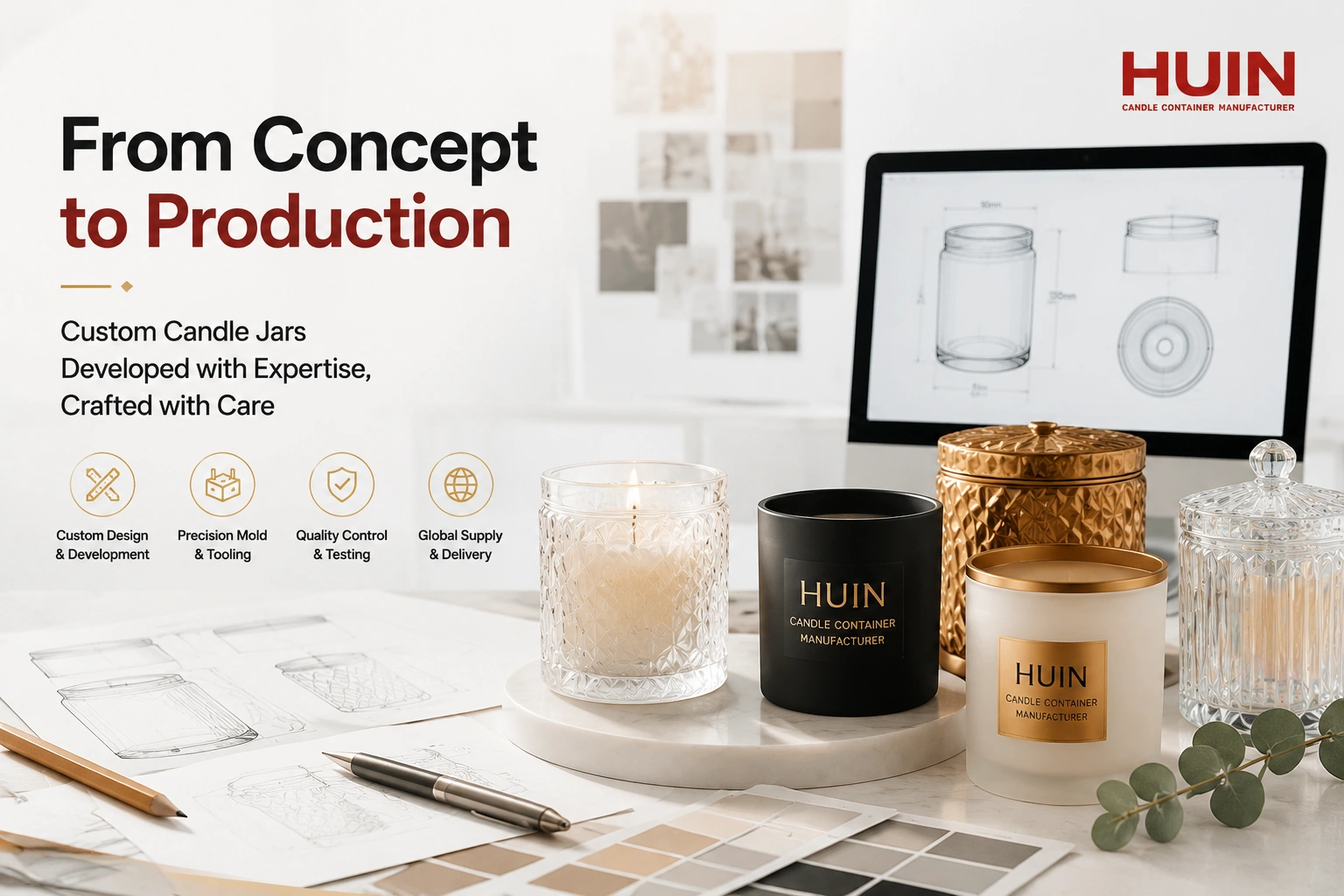
How Are Custom Candle Jars Developed From Concept to Production?
A risk-controlled development process covering concept review, feasibility evaluation, mold development, sampling, finishing, packaging, and scalable production.
Quick Answer
Custom candle jar development usually follows eight stages: requirement definition, engineering feasibility review, mold development, sampling, surface finishing, production validation, packaging engineering, and final delivery. A professional candle jar manufacturer focuses not only on creating a sample, but also on ensuring the product can be manufactured consistently at commercial scale.
A custom candle jar is more than a container with a unique appearance. For candle brands, the development process must connect creative design with manufacturing reality.
Factors such as structure, mold complexity, finishing methods, production stability, packaging protection, and repeat-order capability all influence whether a design can become a successful commercial product.
At HUIN, custom candle jar development is managed as a structured manufacturing process designed to reduce production risks and support reliable global supply.
The 8 Stages of Custom Candle Jar Development

Stage 1: Concept and Requirement Definition
Every successful candle jar development project begins with a clear understanding of product goals and brand requirements.
Key considerations include:
- Product positioning and target market
- Jar shape, size, and capacity
- Surface finish and visual direction
- Logo and decoration requirements
- Target quantity and budget expectations
Clear requirements help reduce unnecessary changes during later development stages.
Stage 2: Engineering Feasibility Review
Before mold development begins, the design needs to be evaluated from a manufacturing perspective.
Engineers review:
- Structural design and dimensional stability
- Wall thickness and base requirements
- Mold complexity and production efficiency
- Surface finishing compatibility
- Repeat-production risks
A visually attractive concept may still require adjustments before it becomes suitable for stable mass production.
Stage 3: Mold Design and Tooling Development
Mold development determines how accurately and consistently a custom candle jar can be produced.
This stage focuses on:
- Mold structure optimization
- Dimensional accuracy control
- Prototype testing and adjustment
- Production repeatability improvement
A well-developed mold supports stable production performance for both initial orders and future repeat production.
Stage 4: Sampling and Prototype Validation
Samples are used to verify whether the design can move from concept into reliable production.
Sample evaluation includes:
- Dimensional accuracy
- Shape consistency
- Weight control
- Surface quality
- Logo and decoration position
- Packaging suitability
Multiple sample adjustments may be required before the product reaches an approved production standard.
Stage 5: Surface Finishing and Brand Decoration
Surface finishing transforms a candle jar from a functional container into a branded product experience.
Common customization options include:
- Custom color matching
- Matte and gloss finishes
- Gradient and soft-touch effects
- Metallic coatings
- Silk-screen printing
- Embossing and debossing
The selected finishing process must balance visual requirements with production stability and long-term consistency.
Stage 6: Mass Production Validation
Before full-scale production, the manufacturing process needs to be validated under realistic production conditions.
Validation focuses on:
- Batch-to-batch consistency
- Defect control
- Color stability
- Structural performance
- Production repeatability
The goal is to ensure the approved sample can be reproduced consistently when production volume increases.
Stage 7: Packaging Engineering
For glass candle jars, packaging is part of the product protection system rather than only a final packing step.
Packaging evaluation includes:
- Inner protection structure
- Carton strength and stacking design
- Pallet loading stability
- Transportation risk analysis
Proper packaging development helps reduce preventable damage during handling and international shipping.
Learn more about how to reduce candle jar breakage in shipping .
Stage 8: Final Production and Global Delivery
After all development stages are validated, the project enters stable production and delivery preparation.
Final production control includes:
- Production scheduling
- Quality inspection
- Batch consistency management
- Export preparation
- Shipment coordination
The objective is not only to create a successful sample, but to deliver a product that can be manufactured reliably at commercial scale.
Why Engineering Validation Matters Before Mass Production
Many production problems cannot be identified from a design image or early sample alone. Without proper validation, brands may experience unexpected issues during large-scale manufacturing.
A structured development process helps reduce:
- Sample-to-bulk production differences
- Unstable finishing quality
- Higher defect rates
- Packaging and shipping risks
- Production delays and unnecessary costs
HUIN's Custom Candle Jar Manufacturing Advantage
As a candle jar manufacturer with its own factory, HUIN connects product design requirements with practical manufacturing execution.
Own Candle Jar Factory
HUIN manages candle jar production through its own manufacturing capability, supporting better process control, quality consistency, and repeat-order stability.
Custom Development Capability
HUIN supports custom candle jar projects from feasibility review and mold development to sampling, finishing, and production optimization.
Explore more about custom candle jar manufacturer capabilities .
Quality and Production Control
Approved samples, technical specifications, inspection standards, and packaging requirements are controlled to support stable mass production.
Export Packaging and Supply Support
HUIN evaluates packaging requirements based on product structure, surface finish, shipment route, handling conditions, and customer expectations to support safer international delivery.
What Brands Should Prepare Before Developing Custom Candle Jars
Clear project information helps manufacturers evaluate feasibility faster and provide more accurate development recommendations.
Product Information
- Reference drawings or product images
- Target jar dimensions and capacity
- Material requirements
- Desired structure and appearance
Brand Requirements
- Brand positioning
- Color preferences
- Logo application method
- Surface finishing expectations
Commercial Requirements
- Expected order quantity
- Target delivery schedule
- Destination market
- Packaging expectations
Summary
Custom candle jar development is not simply a design-to-production process. It is an engineering system that connects creativity, manufacturing capability, quality control, packaging protection, and long-term supply reliability.
A successful development process includes:
- Concept definition
- Manufacturing feasibility evaluation
- Mold development
- Sample validation
- Finishing optimization
- Production control
- Packaging engineering
- Stable global delivery
For global candle brands, choosing a manufacturer with development capability helps transform creative ideas into scalable commercial products.
Frequently Asked Questions
How long does custom candle jar development take?
The timeline depends on design complexity, mold requirements, surface finishing, sample revisions, production quantity, and validation requirements. A realistic schedule can be confirmed after the feasibility review.
What happens before a custom candle jar mold is developed?
The design is reviewed for structure, dimensions, production feasibility, mold complexity, finishing compatibility, quantity requirements, packaging needs, and potential manufacturing risks.
Why are multiple sample rounds sometimes required?
Sample adjustments may be needed to optimize dimensions, shape, color, surface finish, logo position, lid compatibility, and production consistency before mass production approval.
How does HUIN control sample-to-bulk production consistency?
Approved samples, technical specifications, quality requirements, inspection standards, and packaging details are used as references during mass production.
When should packaging be considered during candle jar development?
Packaging should be considered during the development stage because jar structure, weight, surface finish, accessories, and shipping conditions directly affect protection requirements.
Can HUIN support the complete custom candle jar development process?
Yes. HUIN supports feasibility evaluation, mold development, sampling, surface finishing, quality control, packaging engineering, production management, and repeat-order support according to project requirements.
Related Reading
Learn more about candle jar manufacturing and supply solutions:
Custom Candle Jar Manufacturer | HUIN OEM/ODM Factory
Reduce Candle Jar Breakage in Shipping | HUIN Packaging Solutions?
How Do Buyers Evaluate Candle Jar Suppliers Beyond Price?